
Remote Work · Philippine Labor & Business Law · 2026 Outlook
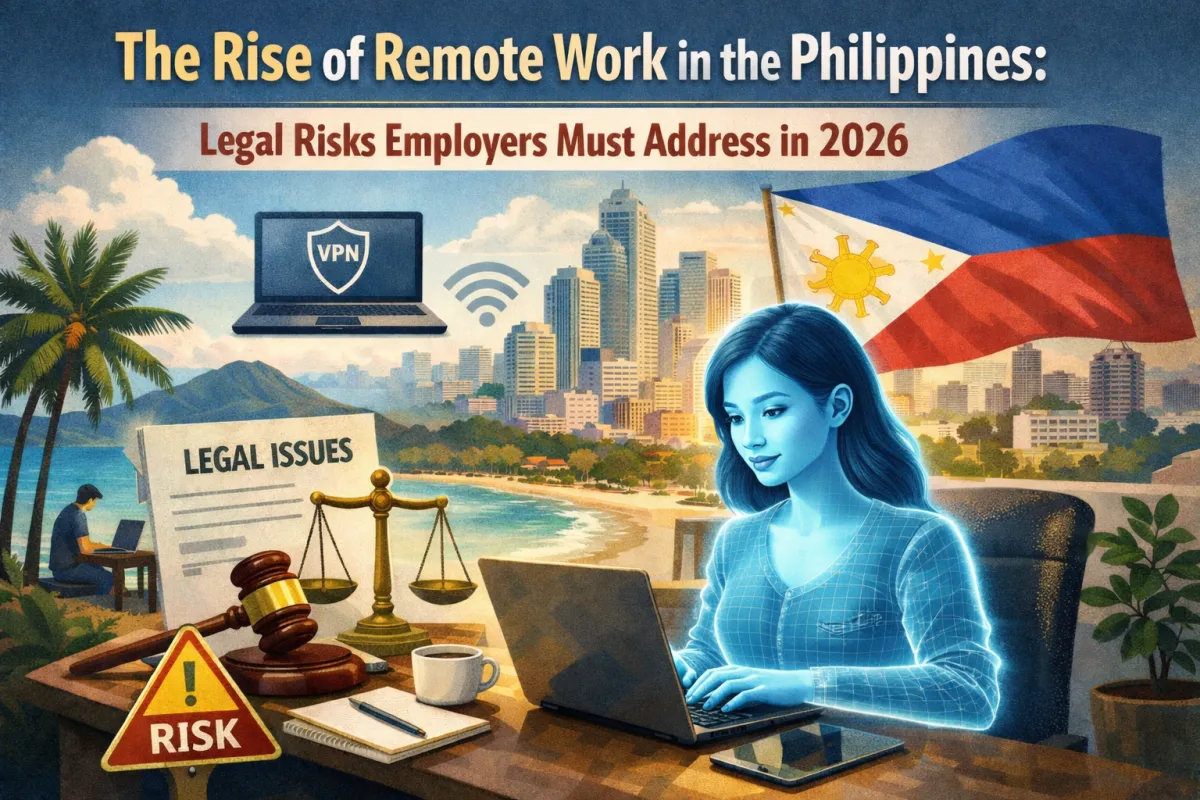
The Rise of Remote Work in the Philippines: Legal Risks Employers Must Address in 2026
As hybrid and fully remote teams become the default in Philippine companies, the real risk is no longer technology—it is non-compliance. Employers who treat remote work as an informal "benefit" instead of a structured legal arrangement are exposing the company to avoidable labor claims, data breaches, and regulatory audits.
This article walks you through the key legal risks of remote work in 2026—grounded in the Telecommuting Act (Republic Act No. 11165), DOLE regulations, data privacy rules, and established due process standards—so you can scale your workforce without creating a future docket of legal disputes.
Author: Philippine Lawyer | Business Consultant | Subscription-Based Legal Advisor
Updated: 13 February 2026
Executive Briefing
Remote work is no longer a pandemic-era workaround—it is now a competitive necessity for Philippine companies hiring top talent, serving global clients, and managing cost-efficient operations. But as remote work models mature, DOLE inspectors, employees, and regulators are also becoming more sophisticated in identifying non-compliance and asserting rights.
For entrepreneurs, OFW-led businesses, and corporate decision-makers, the core question in 2026 is not whether to allow remote work—it is how to structure it legally so that it aligns with Philippine labor law, data privacy rules, and commercial realities.
“Remote work is not a legal grey area. It is a regulated mode of work. Your policies must catch up.”
In the sections that follow, we translate the law into actionable decisions: how to design your telecommuting policy, structure compensation and overtime rules, protect confidential data, and enforce due process even when your team rarely steps into a physical office.
1. Legal Basis: Telecommuting Act and DOLE Regulations
Remote work in the Philippines is primarily governed by Republic Act No. 11165, also known as the Telecommuting Act, and its Implementing Rules and Regulations (IRR) issued by the Department of Labor and Employment (DOLE). These are complemented by DOLE Department Orders and existing labor standards on wages, hours of work, and benefits.
- Telecommuting is defined as a work arrangement where an employee regularly performs work from an alternative workplace using telecommunication or computer technologies.
- Participation in telecommuting programs must be voluntary, based on a mutually agreed arrangement between employer and employee.
- Remote workers must be treated fairly with respect to hours of work, compensation, benefits, training, and career development opportunities.
- Employers are required to ensure fair treatment, data protection, and safe work conditions as far as practicable.
In addition to RA 11165, employers should monitor DOLE Department Orders, Labor Advisories, and policy issuances that refine the application of telecommuting rules—particularly on recording work hours, occupational safety in a home office, and company obligations when providing equipment or connectivity allowances.
A compliant remote work policy in 2026 should explicitly reference RA 11165 and its IRR, clarify how the company applies these standards, and ensure that internal rules do not dilute statutory employee rights.
2. Compensation and Overtime: The Hidden Remote Work Liability
Many employers wrongly assume that because employees are at home, overtime and premium pay obligations are more flexible. Under Philippine law, the place of work does not change the core rules on hours of work. If your remote employee is rank-and-file and performs work beyond the standard workday, overtime rules still apply unless a valid exemption exists.
Risk pattern we frequently see: remote employees answering client messages late at night, attending unrecorded after-hours calls, or submitting deliverables on weekends—without formal timekeeping but still under management supervision or expectation. These scenarios are fertile ground for future money claims.
- Clarify whether employees are classified as exempt or non-exempt from overtime under existing DOLE rules.
- Implement a reliable, auditable timekeeping system for remote work (not just informal chats or email timestamps).
- Define rules for after-hours communications, weekend work, and emergency support, including how these are compensated.
- Document approval processes for overtime and clearly state that unapproved overtime is discouraged but still compensable if work is performed.
- Align allowances (internet, electricity, equipment) with clear documentation to avoid them being misconstrued as wage distortions.
From a risk-management perspective, underpayment and misclassification issues often cost more than the cost savings gained from not renting a larger office. A well-structured remote work policy should integrate timekeeping, overtime approval, and compensation rules that can withstand DOLE inspections and labor arbitration scrutiny.
3. Data Privacy and Cybersecurity in a Distributed Workforce
Remote work amplifies your exposure under the Data Privacy Act of 2012 and National Privacy Commission (NPC) issuances. Laptops move in and out of homes, public spaces, and even across borders. Employees may use personal devices, unsecured Wi-Fi, and third-party apps outside your standard IT stack.
For businesses handling client data, financial information, health records, or large volumes of personal information (including employee data), a generic IT policy is no longer sufficient. You need a remote work–specific data protection framework that addresses how, where, and by whom data is accessed and stored.
- Device control: Define whether employees may use personal devices and, if so, under what security requirements (encryption, antivirus, screen lock, etc.).
- Access management: Implement role-based access controls and restrict downloading or offline storage of sensitive data where possible.
- Network security: Require use of secure networks or VPNs, and prohibit work on open public Wi-Fi without proper safeguards.
- Data handling: Set clear rules on printing, physical document storage at home, and disposal of confidential materials.
- Incident response: Establish protocols for lost devices, suspected breaches, and reporting obligations to management and, when required, the NPC.
- Cross-border issues: If your remote workers access or transfer data outside the Philippines, review cross-border data transfer requirements and client contractual commitments.
From an enforcement perspective, regulators and clients will not accept “we were working from home” as a defense to a data breach. Your remote work policy must be aligned with your privacy notices, data processing agreements, and internal data governance framework.
4. Termination and Due Process in a Remote Setup
The shift to remote work has not relaxed the constitutional and statutory requirement of due process in employee termination. What has changed is the logistics of how employers serve notices, conduct investigations, and hold administrative hearings when the parties are not in the same physical space.
The twin-notice and hearing requirement still applies. However, technology can be used to comply—provided the employee is given a genuine opportunity to be heard and to defend themselves, and the company can prove that notices were properly served and that the process was fair.
- Notices: Use verifiable channels (courier to registered address, official email, or employee portal) and maintain proof of transmission and receipt.
- Virtual hearings: Allow the employee to attend via video conference, be assisted by counsel or representative, and present explanations or evidence.
- Documentation: Keep detailed minutes, screenshots, recordings (with proper consent), and written findings to support the decision.
- Grounds: Ensure that grounds for termination are lawful, clearly documented, and reasonably connected to performance or misconduct—even when related to remote work behavior (e.g., abandonment, data misuse, repeated non-compliance with work-from-home protocols).
- Return of property and access offboarding: Define clear procedures to recover devices, revoke system access, and secure company data immediately upon separation.
Courts and arbitrators will increasingly scrutinize whether employers adapted their procedures to the realities of remote work, or simply forced old processes into a new context. A well-designed remote HR and legal framework can preserve managerial flexibility while respecting employee rights.
5. Practical Compliance Checklist for Remote Work in 2026
Use this high-level checklist to quickly assess whether your current remote or hybrid work arrangements are legally and operationally aligned with Philippine standards:
- Written Policy: Do you have a formal, signed telecommuting or remote work policy that cites RA 11165 and DOLE guidelines?
- Voluntary Participation: Are participation terms (including eligibility and duration) clearly documented and mutually agreed?
- Timekeeping: Is there a consistent, auditable method of logging work hours, overtime, and rest days for remote staff?
- Compensation: Are overtime, night shift differential, and holiday pay rules documented and applied to remote employees where applicable?
- Equipment and Allowances: Are responsibilities for devices, software, connectivity, and maintenance defined in writing?
- Performance Management: Are performance metrics, deliverables, and communication expectations adapted for remote work?
- Data Privacy: Do you have a documented data protection policy for remote work, aligned with the Data Privacy Act and NPC rules?
- Security Controls: Are there minimum IT security standards for home setups (VPN, device encryption, password policies)?
- Health and Safety: Have you addressed occupational safety and health considerations in a telecommuting context?
- Due Process: Are your investigation and termination procedures remote-ready (notices, hearings, documentation, offboarding)?
If you answered “no” or “not sure” to several items, it is a signal to revisit your remote work framework before a dispute, audit, or client requirement forces a rushed response.
Turning Remote Work Risk into a Strategic Advantage
Remote work is not just an HR policy; it is a strategic asset. Companies that formalize their telecommuting arrangements, align them with labor and data privacy laws, and embed them into operations will recruit better talent, negotiate stronger contracts, and manage risk at a lower cost.
Whether you run a lean startup, a growing BPO, or a professional services firm with offshore clients, your remote work strategy should be designed like any other business system—documented, tested, and legally sound. This is where structured, subscription-based legal advisory can be particularly valuable: you get continuous support as your team, tools, and regulations evolve.
Need help structuring a compliant remote work policy that supports growth? We work with Philippine businesses, founders, and corporate teams to design telecommuting frameworks that are both legally defensible and operationally realistic.
Frequently Asked Questions on Remote Work Compliance in the Philippines
These are some of the practical questions that founders, HR heads, and corporate leaders typically raise when shifting to or expanding remote work arrangements.
1. Is a written remote work policy legally required under the Telecommuting Act?
RA 11165 and its IRR require that telecommuting arrangements be based on a mutually agreed program between employer and employee. In practice, this means that a written policy or individual telecommuting agreement is strongly recommended, and often necessary, to prove compliance with standards on voluntariness, fair treatment, data protection, and working conditions. For companies with multiple remote staff, the absence of a written framework is a significant legal and operational risk.
2. Can we classify remote workers as independent contractors to avoid overtime and benefits?
Simply labelling a worker as a “contractor” because they work from home does not override the four-fold test of employment applied by Philippine courts (selection, payment of wages, power of dismissal, and control). If your company exercises control over how, when, and where work is done, and the worker is integrated into your business, they are likely an employee regardless of their location. Misclassification can result in back wages, benefits, penalties, and potential findings of labor-only contracting.
3. How do we properly conduct an administrative hearing if the employee is fully remote or abroad?
You may conduct hearings via video conference or hybrid setups, provided you comply with twin-notice requirements, give the employee reasonable time to prepare, and allow them to explain their side with assistance from a representative or counsel. It is important to document invitations, attendance, questions, and explanations given. If time zones or connectivity are an issue, explore alternative schedules or written submissions, and record in writing how the company accommodated the employee’s circumstances.
4. Are we liable if an employee working from home suffers an injury during work hours?
Occupational safety and health (OSH) obligations continue to apply in a telecommuting context, although the practical scope is different from a traditional office. Employers should define reasonable OSH standards for home offices, provide guidance on ergonomics and safe workspaces, and clarify reporting procedures for work-related incidents. Liability will depend on the facts of each case, but having a documented OSH framework for remote work helps demonstrate that the company exercised due diligence.

Atty. Edwin D. Man
Legal Guide Ph is produced by a Philippine-based team of lawyers and business consultants.
Every article in this blogs go through an Ai + lawyer insights. This is a balance of legal precision and commercial judgment of the blog contents.
Philippine Lawyer
Entrepreneur
Founder
Important Legal Disclaimers
The information on this blog is provided for general informational purposes only and does not constitute legal advice, tax advice, or a legal opinion. Reading this content or contacting us through this website does not create an attorney–client relationship.
Laws and regulations in the Philippines change over time and can apply differently depending on specific facts and circumstances. Before acting on any information found here, you should obtain advice from qualified Philippine counsel or your own professional advisers.
Some content may contain discussions but such discussions are not intended or written to be used, and cannot be used, as a substitute for legal advisory, promotion or recommending any transactions.
© 2026 Premium Legal Insights · Philippine Legal & Business Advisory