
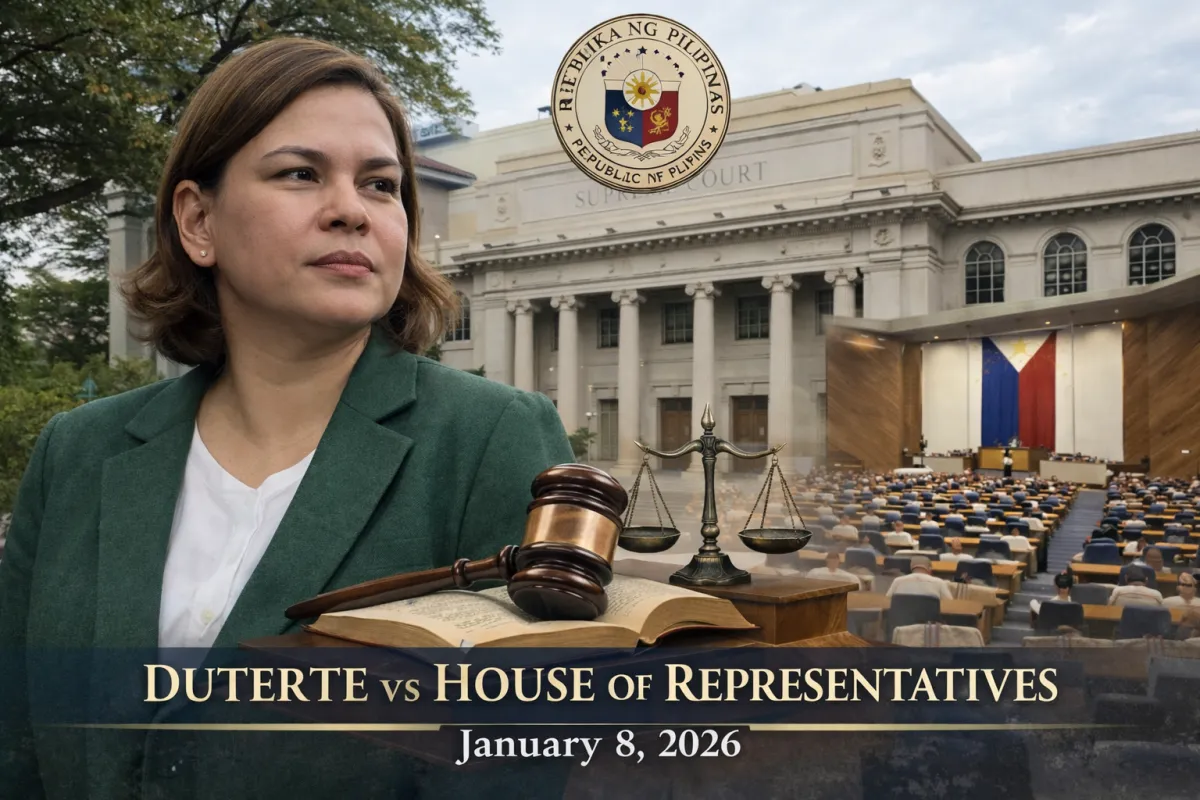
Duterte vs House of Representatives [ G.R. Nos. 278353 and 278359. January 28, 2026 ]
(Case Ai Digest)
Executive Summary
I. OVERVIEW
The Supreme Court En Banc denied the Motion for Reconsideration of the House of Representatives and affirmed its July 25, 2025 Decision, declaring the fourth impeachment complaint against the Vice President unconstitutional and void ab initio.
The Resolution is doctrinally significant because it:
Clarified the constitutional limits of the House’s “sole power to initiate impeachment.”
Recalibrated the meaning of “session days” under Article XI, Section 3(2).
Expanded the understanding of when impeachment is “initiated” for purposes of the one-year bar.
Declared that due process applies to both modes of impeachment initiation.
Defined the proper scope of judicial review over impeachment proceedings.
II. CONSTITUTIONAL FRAMEWORK
The Court’s ruling pivots on Article XI, Section 3 of the 1987 Constitution, particularly:
Sec. 3(2) – First Mode: Filing by a Member or citizen endorsed by a Member.
Sec. 3(4) – Second Mode: Filing by at least one-third of all Members.
Sec. 3(5) – One-year bar rule.
The Court reiterates that impeachment is:
“Primarily a legal, political, and constitutional procedure. It is not a purely political proceeding.”
This is doctrinally critical. The Court explicitly rejects the view that impeachment is beyond judicial scrutiny.
III. CORE CONSTITUTIONAL TENSION
A. The House’s Argument
The House relied on:
Article XI, Section 3(8) – Congress may promulgate its own impeachment rules.
Its internal Rules of Impeachment (19th Congress).
The claim that its interpretation of “session day” and archiving practices were internal matters beyond judicial review.
The doctrine in Francisco v. House of Representatives (2003), arguing that initiation occurs only upon referral and/or plenary action.
The House asserted:
It has discretion to determine when constitutional periods begin.
It may archive complaints without triggering the one-year bar.
Its internal proceedings are non-justiciable.
B. The Supreme Court’s Position
The Court draws a clear constitutional boundary:
The House has the sole power to initiate impeachment — but not to violate the Constitution in doing so.
1. On “Session Days”
The Court held:
For constitutional purposes, a “session day” means a calendar day when the House holds plenary session.
The House cannot redefine session days to delay constitutional timelines.
This is a direct limitation on legislative procedural autonomy when constitutional mandates are involved.
2. On Mandatory Referral (First Mode)
Under Sec. 3(2), the Constitution requires:
Inclusion in Order of Business within 10 session days.
Referral to Committee within 3 session days.
The Court ruled:
These periods are mandatory.
Neither the Speaker nor the Secretary General has discretion to delay them.
Failure to comply triggers constitutional consequences.
The House’s archiving maneuver did not suspend constitutional timelines.
3. On the Second Mode (One-Third Filing)
The House argued that once 1/3 of Members sign, impeachment is automatically constituted and transmitted.
The Court clarified:
Referral to Committee is not mandatory under the second mode.
However, the second mode is still subject to: The one-year bar Due process Constitutional safeguards
The Court refused to allow the second mode to be weaponized to bypass constitutional safeguards triggered by earlier complaints.
IV. THE ONE-YEAR BAR: EXPANDED DOCTRINE
The most significant doctrinal development concerns when impeachment is “initiated.”
Building on Francisco and Gutierrez v. House, the Court ruled:
For purposes of the one-year bar, initiation occurs when:
A complaint is referred to the Committee on Justice; OR
A properly endorsed complaint is not acted upon within constitutional periods; OR
The House adjourns sine die without acting on it.
This is crucial.
The Court held that:
Archiving and inaction cannot be used to evade the one-year bar.
Thus, the first three complaints—though archived—were deemed initiated for purposes of Section 3(5).
Therefore:
The fourth complaint (filed under the second mode) was barred.
It was void ab initio.
V. JUDICIAL REVIEW VS. “SOLE POWER”
A. Constitutional Theory
Article VIII, Section 1 grants the Court power to determine grave abuse of discretion by any branch.
The Court reaffirmed:
Impeachment is not beyond judicial review.
The Court does not decide guilt.
It reviews constitutional compliance.
This preserves separation of powers while enforcing constitutional supremacy.
B. The Court’s Limiting Doctrine
The Court emphasized:
It does not determine who should be impeached — only whether constitutional requirements were followed.
This preserves the political nature of impeachment while subjecting procedure to constitutional scrutiny.
VI. DUE PROCESS: A MAJOR DOCTRINAL SHIFT
The Resolution strongly emphasizes:
The Bill of Rights applies to impeachment.
Due process applies even at the initiation stage.
Due process in impeachment is “sui generis.”
The Court laid down fairness requirements for the second mode:
Articles must be accompanied by evidence.
Evidence must meet the House’s quantum threshold.
Endorsing Members must have seen the evidence.
Charges must relate to acts during current term.
Acts must qualify as impeachable offenses under Article XI, Section 2.
This constitutionalizes evidentiary discipline in impeachment initiation.
VII. INTERNAL RULES VS. CONSTITUTION
Critical Holding:
The House’s rules are presumed valid, but:
They cannot be interpreted in a way that defeats the Constitution.
The Court rejected a purely textual reading of the House Rules if it would:
Allow manipulation of timelines
Circumvent the one-year bar
Undermine due process
Thus:
Legislative procedural autonomy ends where constitutional mandate begins.
VIII. SILENT EFFECTS OF THE RESOLUTION
Beyond the explicit holdings, the Resolution has deep structural consequences:
1. It Curtails Strategic Archiving
The House can no longer:
Freeze minority-filed complaints
Activate a majority-backed complaint later
Avoid the one-year bar through procedural delay
This fundamentally reshapes impeachment politics.
2. It Strengthens Minority Protections
By treating inaction as triggering initiation, the Court:
Prevents majority dominance from nullifying minority complaints.
Ensures constitutional timelines cannot be weaponized.
3. It Elevates Impeachment to a Hybrid Constitutional Process
The ruling reinforces that impeachment is:
Political in outcome
Legal in structure
Constitutional in procedure
This is a doctrinal balancing framework for future impeachment cases.
4. It Expands Judicial Review Doctrine
The Court clarifies that:
Even constitutionally “sole” powers remain reviewable for grave abuse.
This strengthens Article VIII judicial power doctrine post-Francisco.
5. It Signals Warning Against Political Engineering
Although the Court states:
“Our ruling does not absolve petitioner Duterte from any of the charges.”
It unmistakably warns against procedural manipulation.
The decision is not about guilt — it is about constitutional compliance.
IX. CASE DIGEST (FRIENDLY SUMMARY)
Case:
Sara Z. Duterte v. House of Representatives, et al.
G.R. Nos. 278353 & 278359
January 28, 2026 (En Banc)
Doctrine:
“Session day” under Article XI is a calendar day when plenary session is held.
The one-year bar is triggered not only by referral but also by unconstitutional delay or adjournment without action.
Archiving cannot defeat the one-year bar.
The second mode (1/3 filing) is subject to due process and constitutional safeguards.
Impeachment is reviewable for grave abuse of discretion.
Legislative internal rules cannot override express constitutional commands.
Disposition:
Motion for Reconsideration DENIED.
Fourth impeachment complaint declared VOID AB INITIO.
X. CONCLUSION
This Resolution is a landmark in Philippine constitutional law.
It does not weaken impeachment.
It strengthens its constitutional legitimacy.
The Court affirmed that:
The House holds the power to initiate.
The Senate holds the power to try.
The Supreme Court ensures constitutional fidelity.
In doing so, the Court preserved the architecture of accountability while preventing its procedural distortion.

Atty. Edwin D. Man
Legal Guide Ph is produced by a Philippine-based team of lawyers and business consultants.
Every article in this blogs go through an Ai + lawyer insights. This is a balance of legal precision and commercial judgment of the blog contents.
Philippine Lawyer
Entrepreneur
Founder
Important Legal Disclaimers
The information on this blog is provided for general informational purposes only and does not constitute legal advice, tax advice, or a legal opinion. Reading this content or contacting us through this website does not create an attorney–client relationship.
Laws and regulations in the Philippines change over time and can apply differently depending on specific facts and circumstances. Before acting on any information found here, you should obtain advice from qualified Philippine counsel or your own professional advisers.
Some content may contain discussions but such discussions are not intended or written to be used, and cannot be used, as a substitute for legal advisory, promotion or recommending any transactions.
© 2026 Premium Legal Insights · Philippine Legal & Business Advisory